

Many sales and contact center teams waste valuable time between calls, but choosing the wrong dialer can create another problem: poor customer experience. That is why the question Predictive Dialer vs Power Dialer: Which One Should You Use? matters for growing businesses in Saudi Arabia.
The right choice can improve agent productivity, reduce manual work, increase conversion, and support better customer communication. In this guide, we explain how both dialers work, when to use each one, what KPIs to track, and how to choose the right solution for your business.
Turn Customer Communication into a Smarter Growth System
Let ICS help you choose the right CRM, cloud contact center, WhatsApp bot, and marketing automation solutions for your business.
What Is an Auto Dialer? Quick Overview
An auto dialer is a calling system that automatically dials phone numbers from a customer or lead list. Instead of asking agents to dial every number manually, the system manages the dialing process and connects answered calls to available agents.
Auto dialers are commonly used in sales, customer service, appointment reminders, follow-up campaigns, and outbound contact center operations. They are usually part of wider Contact Center Solutions, Call Center Solutions for Businesses, or a Contact Center System for Businesses.
For medium and large companies in Saudi Arabia, auto dialers help teams handle higher call volume, improve follow-up, and reduce wasted time. When connected with a CRM System for Businesses, they also help turn calls into structured customer records, pipeline updates, and measurable business outcomes.
To manage customer data, follow-ups, and sales opportunities more effectively, companies can rely on a customer relationship management system that connects teams and improves the customer journey.
What Is a Predictive Dialer and How Does It Predict Agent Availability?
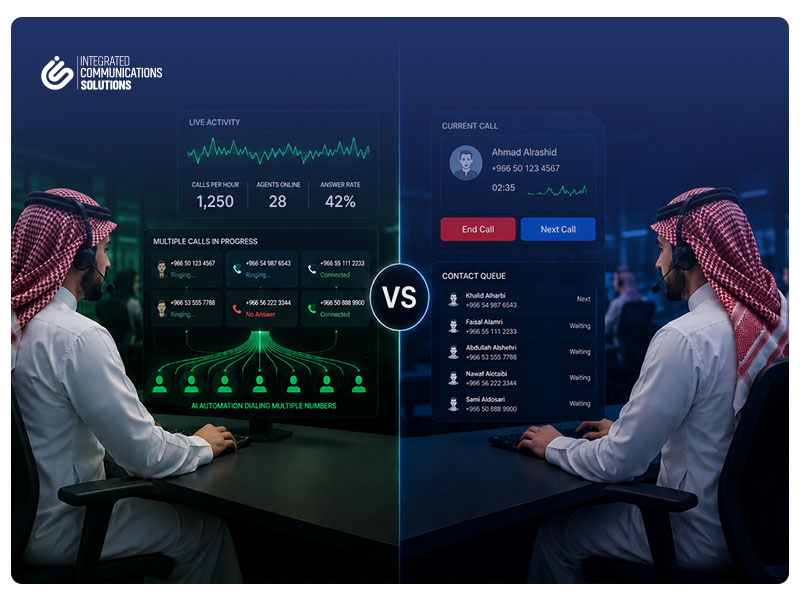
A predictive dialer is an advanced type of auto dialer that calls multiple numbers at the same time. It uses data to predict when agents will become available and how many customers are likely to answer.
The system looks at factors such as:
- Average call duration.
- Number of available agents.
- Historical answer rate.
- Call abandonment risk.
- Time between calls.
- Campaign performance.
The goal is to reduce agent idle time and maximize live conversations. Instead of waiting for one call to finish before dialing the next number, the predictive dialer works ahead and prepares the next answered call.
This makes it powerful for large outbound campaigns, but it also requires careful setup. If the system dials too aggressively, a customer may answer before an agent is available. This can lead to waiting time or abandoned calls.
Businesses looking to modernize customer service should explore the key cloud contact center benefits before investing in a new communication system.
Predictive Dialer vs Power Dialer: Core Differences
The core difference between a predictive dialer and a power dialer is how each system controls call speed and agent connection.
| Factor | Power Dialer | Predictive Dialer |
|---|---|---|
| Mechanism | Calls one number per available agent | Calls multiple numbers based on prediction |
| Speed | Faster than manual dialing, but controlled | Very fast for high-volume campaigns |
| Risk Level | Lower risk of abandoned calls | Higher risk if not configured properly |
| Best Use | Quality sales calls and smaller teams | Large campaigns and maximum reach |
| Customer Experience | More controlled and smoother | Can be strong, but needs monitoring |
| Agent Workload | Balanced | Can be intense if settings are aggressive |
A Power Dialer gives agents more control and reduces the risk of customer wait time. A Predictive Dialer focuses on maximum calling efficiency, especially when the company has large lists and enough agents to handle answered calls.
Quick Comparison of Other Dialer Types
Besides power and predictive dialers, companies may also use progressive and preview dialers.
Power Dialer
Best for sales teams that want higher productivity without losing control. It calls the next number automatically when the agent becomes available.
Progressive Dialer
Best when the agent needs to see customer data before the call starts. It gives more context than a power dialer and is useful for follow-ups, renewals, and relationship-based sales.
Preview Dialer
Best for high-value customers or sensitive conversations. The agent reviews the customer profile first, then decides when to place the call.
Predictive Dialer
Best for large campaigns where the goal is to reach as many customers as possible in the shortest time, while still monitoring quality and abandon rate.
The right choice depends on campaign size, customer value, data quality, and the level of personalization required.
A reliable cloud contact center software helps businesses manage inbound and outbound calls, monitor team performance, and improve customer support from one platform.
When to Choose a Power Dialer
A power dialer is usually the better choice when quality, control, and customer experience are more important than extreme call volume.
Choose a power dialer when:
- Your sales team is small or medium-sized.
- Your agents need time to understand each customer.
- You sell services that require explanation.
- Your customer list includes qualified leads.
- You want to reduce manual dialing but keep control.
- You need a smoother customer experience.
- You want better alignment with CRM follow-up.
For example, if your team is following up with leads who requested a proposal, a power dialer may be more suitable. It helps agents move faster while still giving them enough focus to handle each conversation properly.
Power dialers work well with Customer Management Solutions and Integrated CRM Solutions, especially when every call needs to update lead status, notes, and next steps.
Before choosing the right communication solution, it is important to understand the cloud contact center vs traditional call center comparison and how each option affects cost, flexibility, and customer experience.
When to Choose a Predictive Dialer
A predictive dialer is better when your company needs high-volume outbound calling and has enough agents to handle fast call flow.
Choose a predictive dialer when:
- You manage large outbound campaigns.
- Your team needs maximum reach.
- You have a high number of contacts to call.
- Your data shows many unanswered calls.
- You have supervisors monitoring performance.
- You can manage abandon rate carefully.
- You need to reduce agent idle time as much as possible.
Predictive dialers are often used by large sales teams, customer follow-up centers, survey campaigns, and high-volume call operations.
For Saudi businesses with multiple branches, large customer databases, or centralized outbound teams, predictive dialing can be effective when it is part of a professional Cloud Contact Center Company setup or a scalable contact center platform.
Companies that handle a high volume of customer calls can improve response speed and service quality by using a cloud contact center to manage conversations more efficiently.
Customer Experience Impact: Wait Time and Dropped Calls
Dialer choice directly affects customer experience. This is very important for companies that care about trust, service quality, and brand image.
With a power dialer, the customer is usually connected to an agent more smoothly because the system dials according to agent availability. This reduces the chance of dropped or abandoned calls.
With a predictive dialer, the system is more aggressive. It may call several numbers before an agent is ready. If a customer answers and no agent is available, the customer may wait or the call may be dropped. This can create frustration.
That does not mean predictive dialers are bad. It means they need clear rules, strong monitoring, and proper configuration.
A good customer experience requires balance: high productivity without making customers feel ignored or rushed. This is why dialers should be connected with Customer Service Solutions for Businesses, CRM data, and quality monitoring.
Our Services
Explore ICS solutions for cloud contact centers, CRM, auto dialers, WhatsApp automation, and marketing technology tools.
KPIs by Dialer Type
To choose and manage the right dialer, companies need to track the right performance indicators.
Connect Rate
This shows the percentage of calls answered by customers. A low connect rate may mean poor data, bad timing, or weak list quality.
Abandon Rate
This is especially important for predictive dialers. It shows how many customers answered but were not connected to an agent quickly enough.
Talk Time
This measures how long agents spend in real conversations. Very low talk time may indicate weak lead quality or poor scripts.
Conversion Rate
This shows how many calls turn into a useful result, such as a qualified lead, booking, proposal request, or closed deal.
Agent Idle Time
This shows how much time agents spend waiting between calls. Predictive dialers usually aim to reduce this number.
Revenue per Agent
This connects calling performance with business value. It helps management understand whether higher call volume is producing real results.
The best dialer is not the one that makes the most calls. It is the one that produces the best balance between productivity, conversion, and customer experience.
Success Prerequisites: Lists, Scripts, QA, and Coaching
A dialer cannot fix a weak sales process on its own. To succeed, your company needs a strong operational foundation.
Start with clean lists. Remove duplicate numbers, wrong contacts, and outdated records. Poor data will reduce connect rate and waste agent time.
Next, prepare a clear call script. It should be short, practical, and flexible. Agents should understand the customer’s likely need and know how to handle common objections.
Quality assurance is also important. Recorded calls should be reviewed to improve performance, identify training gaps, and protect service quality.
Finally, provide continuous coaching. Sales and support agents need guidance on how to use the system, update CRM records, follow up properly, and improve conversations.
These elements make dialers more effective inside Call Center Solutions for Businesses and Customer Service Platforms.
Common Mistakes When Picking a Dialer
Many companies choose a dialer based only on speed, but this can lead to poor results.
Common mistakes include:
- Choosing predictive dialing without enough agents.
- Using a power dialer for campaigns that need massive reach.
- Ignoring customer experience and focusing only on call volume.
- Launching campaigns with weak or outdated data.
- Not integrating the dialer with CRM.
- Using the same script for all customer segments.
- Not tracking abandon rate, conversion, or revenue per agent.
- Failing to train supervisors and agents before launch.
The dialer should match the business goal, not just the technical preference.
A Simple Checklist to Choose the Right Dialer
Before choosing between a predictive dialer and a power dialer, ask these questions:
- How many calls does your team need to make daily?
- How many agents are available during the campaign?
- Is your priority quality or maximum reach?
- Are your customer lists clean and segmented?
- Do agents need to review customer history before calling?
- Is the campaign for cold outreach, warm leads, follow-up, or service?
- Do you have supervisors to monitor performance in real time?
- Can your team manage abandon rate properly?
- Will the dialer integrate with your CRM system?
- Do you need a scalable cloud-based contact center solution?
If your answers focus on control, quality, and lead follow-up, a power dialer may be the better option. If your answers focus on high volume, large lists, and maximum reach, a predictive dialer may be more suitable.
FAQs
What is the main difference between a predictive dialer and a power dialer?
A power dialer calls one number for each available agent, while a predictive dialer calls multiple numbers and predicts agent availability to increase call volume.
Is a predictive dialer always better than a power dialer?
No. A predictive dialer is better for large campaigns, but a power dialer is often better for quality conversations, smaller teams, and controlled follow-up.
Which dialer is better for sales teams?
It depends on the sales process. Power dialers are better for qualified leads and proposal follow-up, while predictive dialers are better for high-volume outreach campaigns.
Can both dialers integrate with CRM?
Yes. Both can integrate with a CRM System for Businesses to update customer records, log call results, create tasks, and manage pipeline stages.
What is abandon rate?
Abandon rate is the percentage of calls where the customer answers but is not connected to an agent quickly enough. It is a key KPI for predictive dialers.
Do dialers help customer service teams too?
Yes. They can support reminders, callbacks, surveys, service follow-ups, and outbound support campaigns as part of wider Customer Service Solutions for Businesses.
Choosing between Predictive Dialer vs Power Dialer: Which One Should You Use? depends on your team size, campaign volume, customer experience goals, and CRM maturity. A power dialer gives more control and better conversation quality, while a predictive dialer supports high-volume campaigns and maximum reach when managed correctly.
For businesses in Saudi Arabia, ICS can help assess your sales and service workflows, recommend the right dialer model, and implement scalable Contact Center Solutions, Integrated CRM Solutions, and cloud communication systems that fit your operational goals.